01 · The Throat
The Aranda-Lowe house, the cellar · thirty-eight hours before the seam closes, 21:10
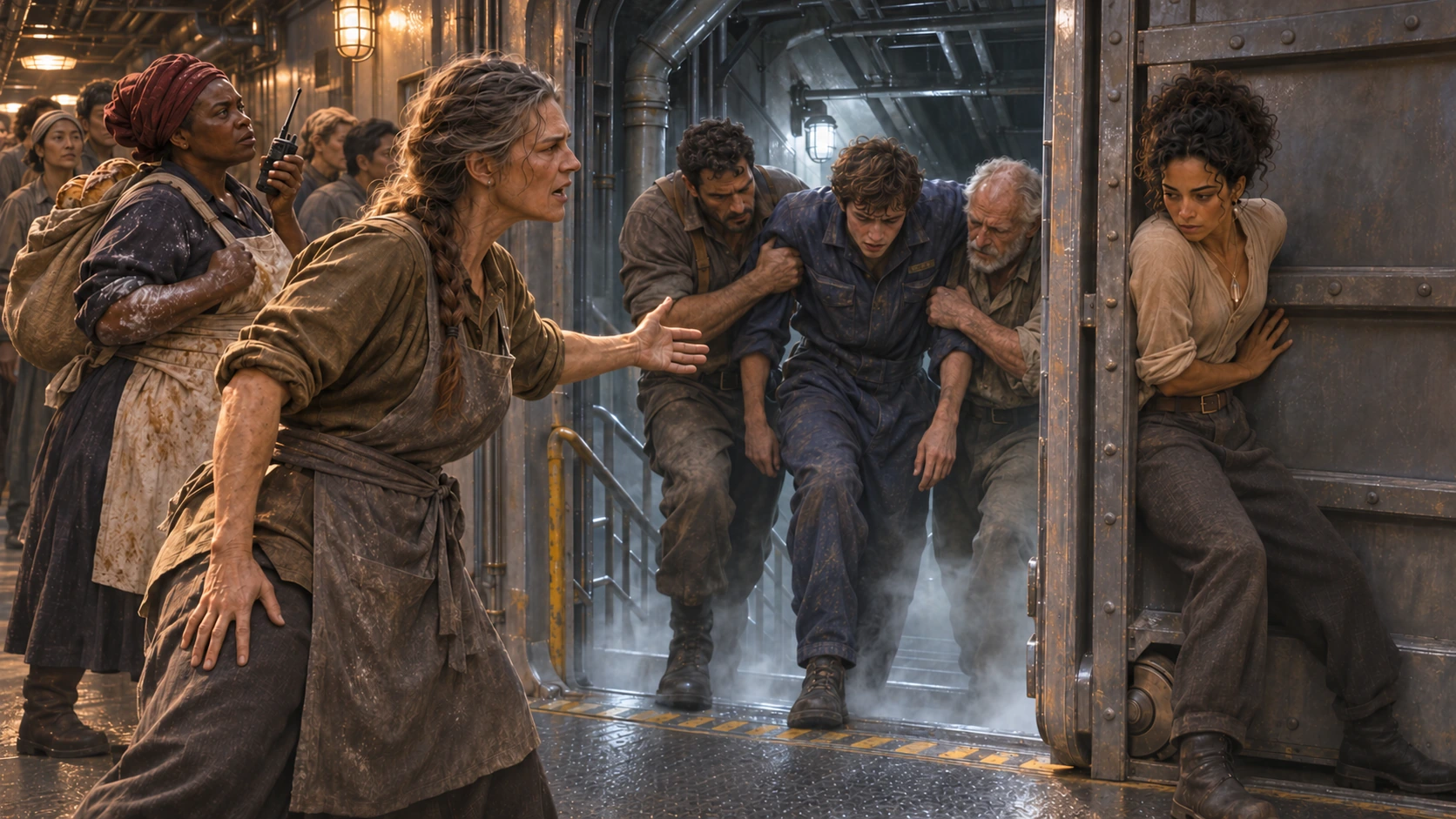
The cellar wall had been cold for two days, and the woman standing at it had stopped noticing that she was cold too. Tabitha Aranda-Lowe wore the coat she had put on Sunday to go to the shop. In one hand she held a torch and in the other a small red wellington boot, and she had not set either down since Monday night.
The crack ran from the floor to the height of her shoulder through limestone her great-grandfather had laid, and it was exactly as wide as a seven-year-old's shoulders. Cold air came out of it in slow breaths that smelled of woodsmoke, wet stone and something sweet, like bread nobody had burned. Six feet in, the passage pinched to a width no grown woman could pass. Tabitha had left skin there.
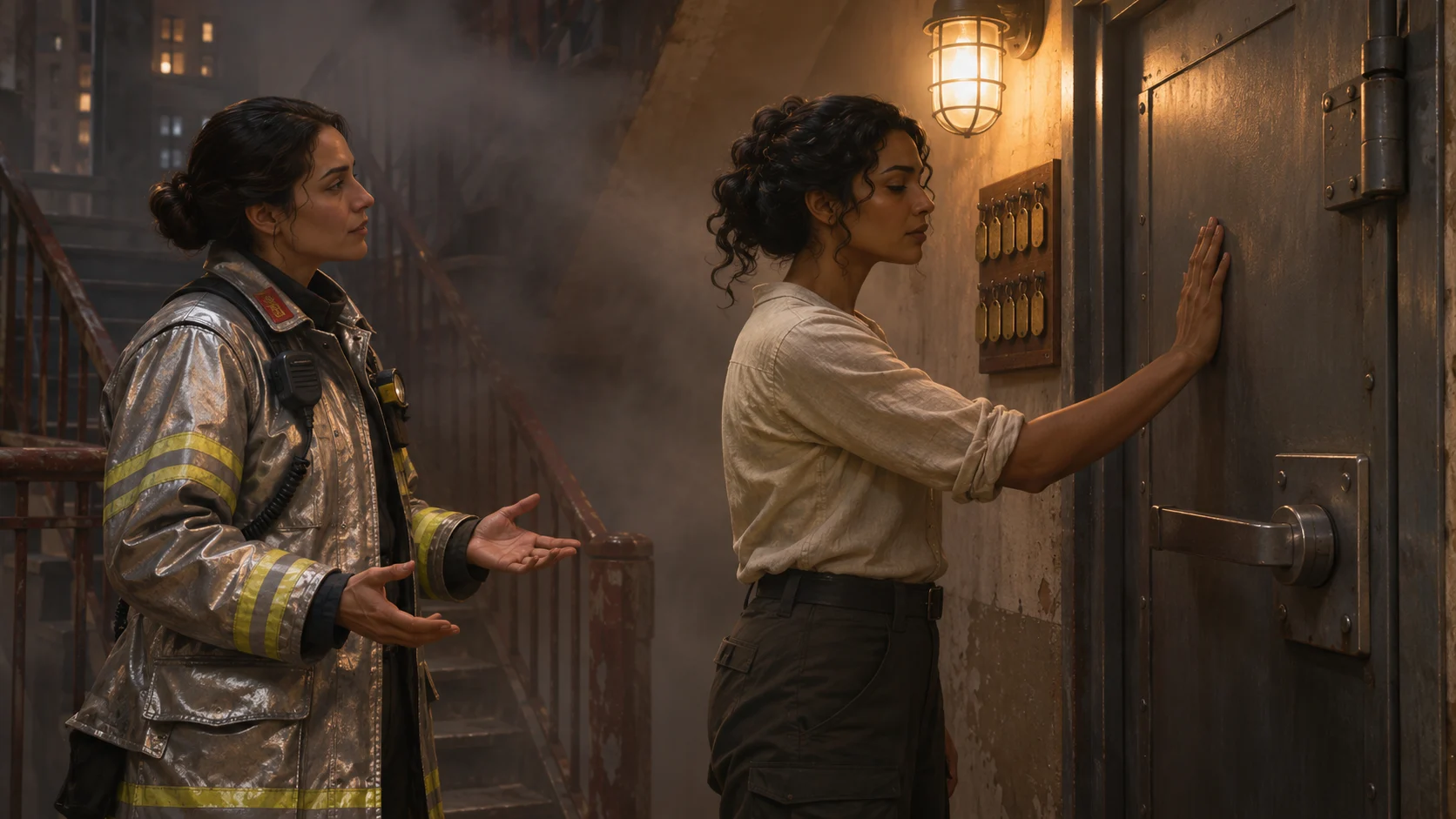
She laid her palm flat on the stone beside the crack. Through it she felt what the seam was doing, the way you feel a door in a draught: not a place but a motion, slow and steady, like a hand deciding to become a fist. It was closing by about a finger's width an hour. There was a great deal of hour left and not enough of it.
TabithaCan you open it?
IlluminaraNo. I can't make it wider and I can't stop it closing. If I forced it, it would tear, and I don't know which side it would tear toward.
TabithaThen what are you for?
IlluminaraFor this. I can hold it exactly as it is for four or five minutes at a time, and keep the air in it still enough that a voice crosses whole. Then I have to stop and rest. I can't hold it for thirty-eight hours. I'm telling you the number before I begin because you have waited two days for somebody to tell you one.
TabithaBegin.
Illuminara set both hands to the stone, and the crack went quiet, as a room goes quiet when someone sits down. Then a child's voice came through it, singing in a language Tabitha did not know, with the tune going up where it ought to have gone down.
TabithaPim.
The singing stopped.
PimMama? Mama, I can hear you properly. It's all clear today.
TabithaYou are coming home. Come to the crack now, and mind the narrow bit.
PimI can't.
TabithaPim Aranda-Lowe, you come here this minute.
PimThat's your not-listening voice.
Tabitha shut her eyes.
PimMama, they fed me. I was cold and I couldn't talk, and Aunt Yeshe put me by the fire and gave me soup, and now I'm her kin. If I go away with nothing, the house stops saying my name. She told me. She didn't say it to be mean. She said it like when you tell me about the stove. I don't want them to stop.
The stillness was taking something from Illuminara, the way a full pan takes something from the arms that carry it across a room. At three minutes she spoke.
IlluminaraPim, my name is Illuminara. Your mother asked me to help. Is that all right with you?
PimOkay. But you have to ask Aunt Yeshe, not only me. It's her house.
At four minutes and forty seconds Illuminara let go. The cellar became a cellar again, and the draught came back, smelling of smoke. Her shirt had stuck to her back. She sat down on the bottom step because her knees suggested it.
TabithaShe isn't stuck. She has simply decided.
IlluminaraShe has decided what she owes. That is different, and it may be easier to work with.
TabithaMay be.
02 · The Third Hearth
The cellar, with the Third Hearth in the crack · thirty-five hours before the seam closes, 00:20
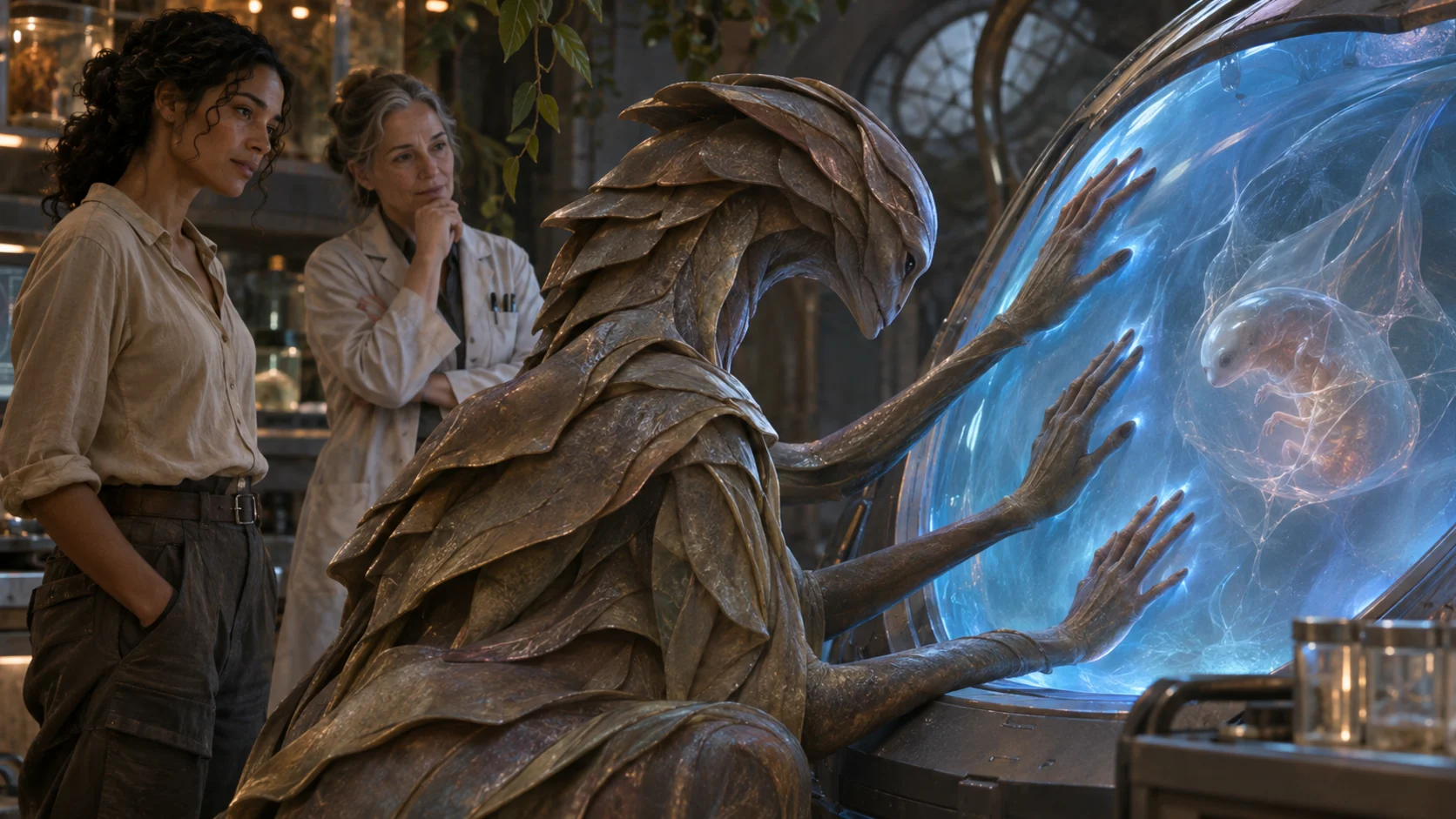
She rested for three hours on the stairs under a blanket that smelled of Marit's lavender, and when she stood again Tabitha was at the wall as if she had never left it. The second window opened on a face, long and the grey of river stone, with dark, wide-set eyes and a slow second lid that closed and opened like a thought being reconsidered. Behind it a hearth burned in a hollow of rock, with a black pot on the coals and small shapes asleep along a bench.
IlluminaraI am Illuminara. The child asked me to speak with the keeper of her house. Have I understood that you are Yeshe of the Third Hearth?
YesheYou have. Tell her mother the child eats well and sleeps by the fire. She has taught my grandchildren a rhyme about a bus.
IlluminaraTell me the law the way you hold it, so that I do not translate it into mine. Pim says a fed guest becomes kin.
YesheA guest who eats at the Third Hearth is hearth-kin. Kin does not leave with empty hands. A leaving with nothing in the hands is a death with no mourners, and a house must stop speaking the name, or it calls and calls into an empty room. I will not send that child out of my house as a thing already dead.
YesheMother of Pim, I answer with a question, and you must not hear it as an insult. When your people have fed a child, and she goes home, do they send her with nothing in her hands?
TabithaWe would stand at the door and wave.
YesheAnd she puts nothing on your shelf, and your shelf goes on without her. Among us that is how a house learns it has been left. Before the Mend, kin came and went at the great tide, and nobody feared a leaving. Then the seam shut for a lifetime, and every leaving became for good, and the gift on the shelf became what a house has of someone who will not come back. I do not know how to leave a shelf bare.
Illuminara kept her palm on the stone and let the silence be as long as it wanted. In the hollow the pot ticked on its coals.
YesheThere is one thing more, though it is no part of the law. The wall knocks, and puts out our fire, and we send the children to the far hollow so that none wander. It is the seam's own breath, the way a shut door still draws air. It has done so all my life. A nuisance, not a door.
Illuminara said she would like to hear more about the knocking, later. She did not say why. With her thumbnail, on the inside of her wrist, she wrote one word as she had written names and numbers in courtrooms for fifteen years: knock.
03 · The Draught Book
The Aranda-Lowe kitchen · thirty hours before the seam closes, 05:10
Marit Lowe had fallen asleep in the armchair by the stove with the kettle still ticking beside her, and Tabitha lowered her voice to the register of someone talking over a sleeping baby.
TabithaGran never let us down the cellar at the turn of the seasons. She put a candle on the third step and said it was the damp. I thought she was keeping us from breaking our necks.
On the table stood a shoebox Marit had brought up from the dresser and then not known how to hand over. It held small notebooks in four different hands, the women of the house, back five generations.
Illuminara read standing, as she read everything she did not want to be dazzled by. Equinox. Candle out. Knocked eleven breaths. Cold hand's width. Midsummer. Candle out, knocked nine. Midwinter. Knocked. Mother says do not look. And in a hand gone brown, under a date from before the war: Put my hand in at the knock. Something took it and held it. Cold to the elbow. Mother says we do not answer a draught.
IlluminaraYour family calls it knocking.
TabithaGran's word. Her mother's before her. Why?
IlluminaraBecause Yeshe's house calls it the same, and puts out its fire when it comes. For longer than either of you has been alive, both houses have been counting the same event from opposite sides, and neither has ever put the two lists on one table. And someone in your family answered it once, and was taught not to.
Tabitha put her hand on the open book as if it might get up and leave.
TabithaAnd you think that is the answer. A handshake through a wall.
IlluminaraI do not know yet that it is an answer. I know it is a fact, and that nobody has put it beside the other one. It is also small. A hand's width is a hand and an arm. It could never have carried a child, and it was never going to be a door. It could carry a hand.
TabithaI'll tell you what it sounds like to me. It sounds like a daughter who is a hand. I want her home. I do not want her home with a hole in her, with a place she goes every season to be handed back.
IlluminaraIs that all you want?
TabithaNo. I want her to be able to say they were good to her. I don't want her mourning people who are alive. I just don't know how to want that and also want her in my kitchen.
IlluminaraNobody is going to ask you to promise her anywhere. If it is yours to make, it is yours to refuse.
Tabitha looked at the stove for a long time. Marit shifted in her chair and said, quite distinctly, candle, and slept on.
04 · Badly Sung
The cellar, the second window · twenty-one hours before the seam closes, 14:00
Yeshe wore a cord of grey wool round her neck, and when Illuminara asked whether her house kept a count, she lifted it over her head and held it up to the firelight. It was knotted in sets of four, hundreds of sets, the oldest pale and flattened with handling. One knot, far down, was tied twice.
YesheEach knot is a knock. My mother tied these and her mother those. We never read it as anything. It is only the house counting that it is still here. The double one is my grandmother's mother. She put her hand out at the knock, and a hand took it. She tied it twice, so that we would remember to be afraid.
Tabitha, who had not been invited to speak, said it anyway, in a voice that did not sound like hers.
TabithaGran counts them too. Eleven breaths, last midwinter.
YesheTwelve, on our side. Someone counts slowly.
IlluminaraYeshe, would you teach me the song of kin? Pim sings it badly, and I would like to know what she has been fed on.
YesheIt is not a song for visitors. Hum low, and sing it to the end.
Illuminara sang. She sang it badly, as she would have sung any language learned in an afternoon, with the vowels leaning and the rhythm borrowed from a nursery tune. It was a list. A name, a breath, a name, a breath, each one a person who had sat at that fire, each line closing on a single rising note that hung in the air until the next line caught it. The last line was Pim's name, and she sang it carefully, because she did not want it left to someone who could not hear it.
Tabitha's hand had come up to cover her mouth.
TabithaThey've put her on the list.
YesheEvery night since the first. She asked me what a list was for, and I told her it is so that nobody who sits here is ever only absent.
Illuminara went back over the song's closing note, and felt something click that she had been circling since the first window.
IlluminaraThe word for the gift on the shelf. Pim says it twice in her rhyme, ha-ru, ha-ru. In the song it has no gift in it. It means: and you will come back to this fire. Is it one word, or two that sound alike?
YesheOne word. The oldest telling says a guest leaves a ha-ru so that they have a reason to return for it. The first ha-ru was a bowl, and nobody leaves a bowl they do not mean to fetch. After the Mend, nobody was fetching anything. We kept the bowl and stopped saying the other half aloud. It was a hard half to say.
IlluminaraSo the law was always a promise that the leaving is not a flight.
YesheIt was. We forgot that it also had a door. But hear me, interpreter. A promise is wind. A gift stays on the shelf. In the long quiet we learned that wind is what is left when the thing is gone. Show me a promise that sits on a shelf.
IlluminaraI do not have one yet. I would like to ask somebody who might.
05 · What Pim Wanted
The cellar, the third window · nine hours before the seam closes, 02:10
By the third window the crack hurt to look at. It was two hands narrower than on the first night, and Tabitha had stopped trying to widen it with her torch. On the shelf beside her stood a jar of saved seed with a taped lid, labelled in Marit's writing: Sweet pea, fence by the shed. Tabitha had carried it down at midnight without being able to say why.
Pim sat on the hearth-stone with Yeshe's grey shawl round her shoulders and the end of a knotted cord in her mouth, in the manner of someone who has thought for a long time and has now come to say so.
IlluminaraPim, your mother and Yeshe are listening, and you may say no to any of this. Do you want to go home?
PimYes. And I want to stay. Both. That's the problem, isn't it? Everybody keeps trying to make me pick one.
PimAunt Yeshe says a gift on the shelf means the house knows you left on purpose. But I don't want to leave something so they can stop looking for me. I want to leave something that needs me to come back.
YesheWhat does a seed need?
PimSomebody to tell it how tall it's got. Mama says sweet peas can't see where they're going, so they just grab. They have to be told.
PimAnd ha-ru means a gift and it means come-back, you said. So if I leave one and come back, she has to leave one and come back as well, and we both go home with something. It goes both ways. That's fair.
YesheThe oldest reading of the law, from a child of seven. The old tellings made it a pair.
She lifted the cord from Pim's mouth, not unkindly, and laid it across her palm.
YesheA house gives its guest a cord, one knot for the leaving and one for every knock she keeps faith with. Pim of the Third Hearth, if you will leave your seeds and your picture, I will leave you this, and the Third Hearth will keep a shelf for the jar.
Tabitha slid down the wall until her face was level with the crack, as near to a child's height as she could manage. She did not look at Yeshe.
TabithaPim. Listen to me, not to anyone else. If the wall never opened again, not at the next knock, not ever, would you still want the jar on that shelf?
Pim considered it with the whole of her face.
PimYes. Then it'd still be there, being told. It would just be sad about it.
TabithaThen I have a condition, and it is mine, not Illuminara's and not Yeshe's. At every knock I am at the wall with my hand on your back. If you want to go to the hand, I will bring you. If you don't, you don't. And when you are old enough to say no, it is yours to say.
YesheA hand on a back is no part of my law. I will tie a knot for it. And if the wall does not open?
IlluminaraThen nobody has broken faith. The wall has. Tie the knot anyway.
YesheA house may withdraw from this. The Second Hearth has sent word that they will not come to it. They say a promise across a seam is a way of being left politely.
IlluminaraAnd you?
YesheI would sooner be left politely than lose the name. I have not said yes, interpreter. I have said what I would keep. Bring the jar to the wall when the tide is at the door, and I will tell you with my hands.
06 · The Main Tide
The cellar and the Throat · twenty minutes before the seam closes, 10:50
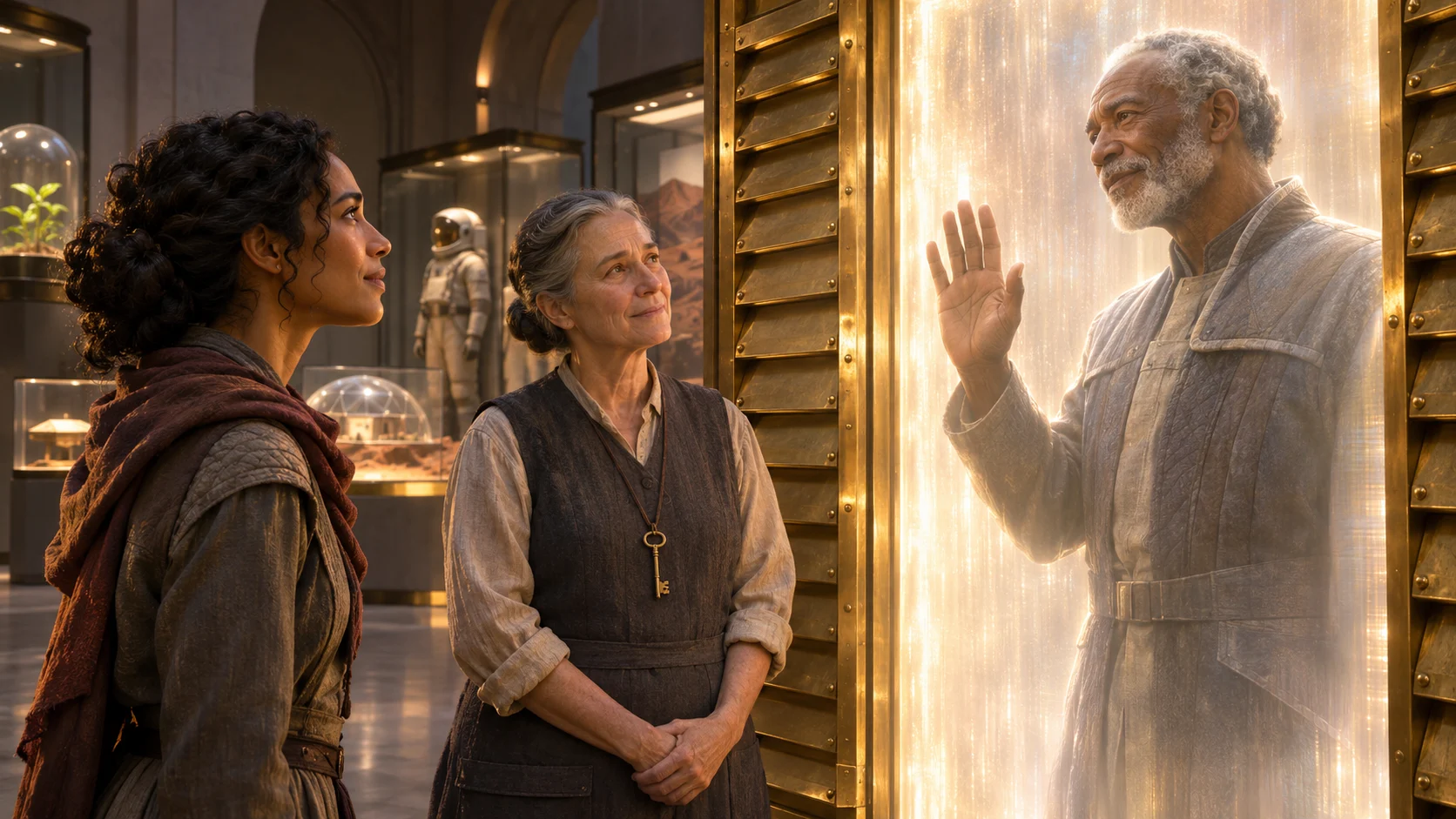
The crack had narrowed to the width of a seven-year-old's shoulders and not a finger more. At the far end of the Throat, a dozen feet off in the firelight, Pim stood in her stockinged feet with the cord round her neck and the shawl folded over her arm, and beside her stood Yeshe, who was taller than any door in the Aranda-Lowe house. On this side Tabitha lay on her stomach on the cold floor with one arm in the Throat to the shoulder, which was as far as it went.
Illuminara set her hands to the stone. She did not say a number this time, because she had said it to everyone who needed it. The window held. She felt each second as a small, specific weight.
The jar went through the pinch in Tabitha's fingers and into a long grey hand that had been waiting for it. Yeshe did not speak. She lifted her mother's clay bowl off the shelf behind the hearth-stone, where it had stood unfetched for sixty years, and set it on the floor to make room, and put the jar in its place. Beside it she pinned a sheet of felt-tip paper on which a round fire, a long grey woman and a small girl were held by a wooden peg. A sound went round the hollow from the shapes on the benches that was not quite a word.
YesheThe Third Hearth has seen the gift. The Third Hearth says yes.
PimI'm going now.
YesheGo, kin.
Pim came through the Throat the way she had gone in, on her stomach, with the cord scraping the limestone, and at the narrowest place she stopped and said in a small steady voice that she was stuck. Nobody breathed. Illuminara did not hold the child. She held the passage exactly as it was, and said breathe out, and Pim breathed out and slid.
Tabitha's hand closed on a small wrist, and then on the other, and then she pulled, with a noise Illuminara decided she would not remember.
Behind her, at the far end, Yeshe sang the single rising note of the last line. Pim, sitting on the cellar floor in her mother's arms, answered it, flat and loud and altogether wrong.
The seam closed. It made a sound like a long breath let out in a room full of people who had been holding theirs. Where the crack had been there was limestone and damp and the fading smell of smoke.
Illuminara slid down the wall. Her hands would not stop shaking. Pim came and sat beside her, solemn, and put the red boot in her lap, which seemed to be what you gave a person after a doorway.
PimYou can have it for a bit.
IlluminaraThank you. Is it a gift or a loan?
PimA loan. You have to give it back.
Illuminara held it. The only word she had for what she felt was astonished, and she was too tired to be ashamed of it.
07 · First Knock
The cellar, the first knock · eleven weeks later, 06:41
A candle burned on the third step. It had burned there four times a year for a hundred years before anyone in the house had known why, and Marit Lowe sat on the step beside it with the draught book on her knee and a pencil behind her ear, wearing the expression of a woman who had been right about something for fifty years and intended to be gracious about it.
Tabitha stood at the wall with one hand flat between her daughter's shoulder blades. The hand was shaking, and she let it shake. Pim stood with her sleeve already pushed up. Illuminara sat on the stairs two steps above the candle, with her hands round a mug, holding nothing at all.
The wall breathed. The cold came first, and then the smell, smoke and wet stone and the sweet one, and the candle flame lay down flat and went out. Low in the limestone a dark line opened a hand's width and did not widen.
A long grey hand came out of it, palm up, with a cord looped over the wrist. Pim put her own hand into it. Her arm went in to the elbow, to the shoulder, and Tabitha's palm followed it, pressed against her daughter's back, as if the wall might still take the rest of her.
YeshePim of the Third Hearth. The sweet peas are up to my knee. They have found the lamp-moss and they are climbing it. They grab everything. I told them they would have to be told.
PimTell them they're doing really well. How many knots?
YesheOne for your leaving. A second for this knock. Feel. And a small one beside them, for a hand on a back. That is not in my law. I have made it so.
PimI missed the song.
Through the crack, cold as a draught and very quiet, Yeshe sang one line of it, the line with the rising note. Pim sang it back, still flat. In the middle of the line the wall made a small noise like a tide going out, and Tabitha's whole arm went rigid, and she did not pull.
YesheThe Second Hearth sent word again. They have turned their guest bench to face the other way. That is theirs to hold, and not yours.
TabithaTell them I am sorry.
YesheI will tell them you said so. They will not hear it yet.
The knock ended as knocks do, without ceremony, the dark line shrinking in a breath. Pim's arm came out of the wall cold to the shoulder, with the cord in her fist. Tabitha knelt and held her with both arms and her face in her hair, and let go in her own time.
PimEleven breaths.
TabithaTwelve.
PimShe counted thirteen.
Marit wrote in the draught book in her square, unhurried hand, under a line in her grandmother's: Midwinter. Knocked. Twelve breaths by T., thirteen by P. Candle out, relit. Hand held.
Tabitha struck a match with fingers that had almost stopped shaking, and lit the candle on the third step again.