01 · The Cell That Would Not Split
Upper Ketter cooperative hall · 12:40
Marit Sokol had watched the cell for nearly three hours without seeing it do anything weather does. At twenty to one it stood over the Greywater range as a single tower fourteen kilometres across, and it had not split. A cell that size splits. It sheds daughters, spreads, and rains itself out over three valleys by evening. This one had held one core against the steering wind since ten to ten that morning, leaning into it like a swimmer, and for the past hour its updraft had swollen and slackened every thirty-eight seconds, as regular as a pulse.
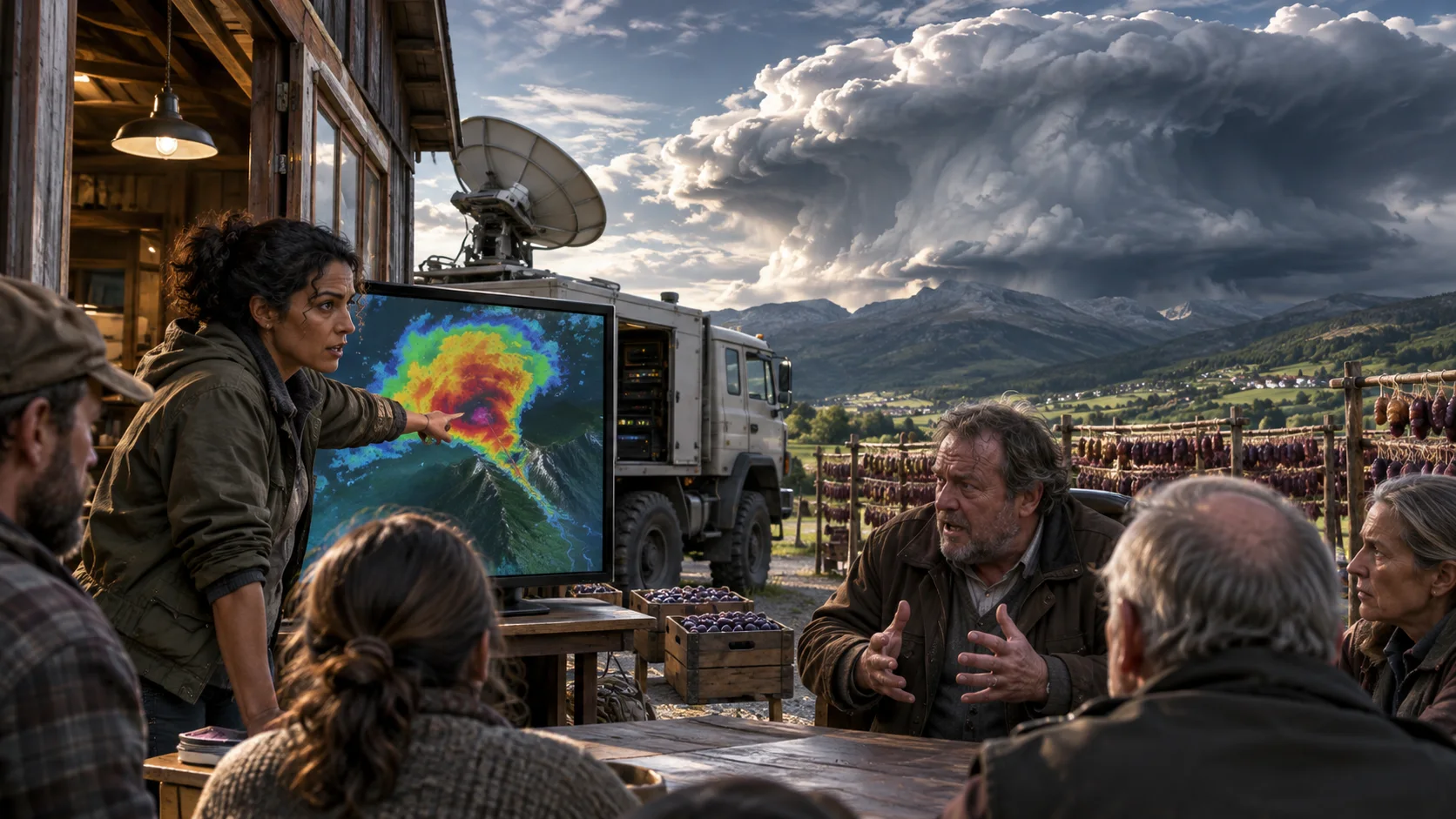
MaritIt has a track.
she told the co-op hall in Upper Ketter, where she had parked her radar truck beside the plum-drying racks.
MaritOver the notch at Greywater, then straight down the Ketter slope. Six villages are on it.
On the wall screen Halvard Teague, who chaired the Calder water board, did not hide that he was frightened, and hid it badly by talking.
TeagueIt carries about eleven million cubic metres. On the Ketter slope it comes down all at once, on saturated clay, on a valley with two thousand people in it. Captain Quill flies at two. We seed it, it rains out over the empty west range, and nobody drowns.
InesAnd nobody drinks.
said Ines Bahr, who ran the Upper Ketter co-op and had once led her whole valley out of its houses for a storm that went round the mountain. They had lost the plums on the racks.
InesEleven million is what Hollin has left, Halvard. Calder has nine weeks of water. And if you order us out again for nothing, next time nobody will go.
Captain Dara Quill stood by the door with her helmet under her arm.
QuillI've seeded two hundred cells. None of them held still while I did it. I'll fly if I'm told to. I'd like it known that I don't like it.
Illuminara had come because Marit sent her the radar loop with three words: it is listening. She had read the cell from the pass road as she read anything under load, as paths of force, and the paths were tidy in a way that weather's were not: one inflow, one core, one slow turn in the lean of the whole tower that looked less like physics than like attention.
IlluminaraHas anyone asked it where it is going?
TeagueAsked it. It's a storm.
IlluminaraIt is a storm that has held one core against the wind for three hours. In my experience, anything that holds against the wind is going somewhere.
Wren Odira, who kept the clock, said there was an hour and twenty before the flight.
02 · The Page
Cooperative hall and mountain ridges · before the 14:00 flight
MaritAnd what do you imagine I can say to it? I can tell you what a line of barrels does. Ten square kilometres of black felt adds less than a thousandth of that cell's power. We cannot push it. A cell leans toward the warmer, wetter inflow, and it can feel a few tenths of a degree, but the barrels are not a hand.
IlluminaraNo. They are a page.
She asked for what the valley had: the felt the plums dried on, three hundred charcoal burners, a hundred and forty volunteers. She would light three ridgelines, A, B and C, to equal heat, with equal fuel burned on each so that the marked ridge could not simply be the hotter one, and Marit would check them with her own thermometers. On one of the three, chosen from a shuffled deck, the burners would flash a pattern, three short and one long, over and over.
Marit would not let it stand on faith.
MaritTwo models.
she said, and wrote them on separate cards.
MaritHeat: it leans toward the warmer inflow, so on equal ridges it leans nowhere. Page: it leans toward the flashing ridge.
Illuminara added the rule beneath and Marit signed it: the core must tilt toward the marked ridge within three minutes, and a draw that missed the window did not count. Ines insisted on shuffling the deck herself. She shuffled it like a woman who had watched people cheat at cards for forty years.
The first card was B. For six minutes the radar showed the core sitting exactly as it had been. At the sixth minute the lean began, long and slow, toward B.
IlluminaraLate.
Illuminara said, and struck the draw from the count.
IlluminaraI assumed it already knew the page. It has to learn it first.
For twelve minutes the crews flashed the pattern on each ridge in turn, four minutes apiece. Then Marit wrote a fresh pair of cards with the same rule, and Ines shuffled again.
The draws came C, B, A, C. The core tilted in two minutes, in ninety seconds, in fifty, in forty. Captain Quill, holding the stopwatch, read out the last one and then, to nobody.
QuillOne in eighty-one, if every ridge is equal and every draw independent.
IlluminaraSlow at first because it was learning the page. That is not what weather does.
TeagueEighty-one to one is a good afternoon.
Teague said from the screen, quietly.
TeagueIt is not a mind.
MaritEqual fuel is not equal feeling. Flashing burners may simply read warmer to it. Ketter's inflow is thicker, and my model gives Ketter four tenths of a degree over Sallow. So keep the heat the same and change only the sign. Put the pattern it has learned on Sallow, and on Ketter flash a pattern it has never been shown, three long and one short, with the same burners, the same fuel and the same rate. I will measure both ridges myself. Heat says Ketter. The page says Sallow.
She wrote both predictions down before the crews moved. Her probes put the two ridges within a tenth of a degree, the same fuel burned on each. In a minute and forty seconds the core leaned toward Sallow, against the warmer road, and Illuminara had both patterns lifted at once and the ridges returned to equal.
MaritIt learned a sign and followed it against the heat.
Marit said, with the unwilling care of someone who had meant to be the sceptic.
MaritI'll not call it more than that.
IlluminaraNor will I. I do not say it is a mind like yours.
TeagueA thing that can learn a sign can choose to flood a valley.
IlluminaraYes. So we find out what it wants.
03 · What It Did Not Hear
Ketter and Sallow ridges · before the 14:30 evacuation
She made her second mistake in the next ten minutes. The page had two words, lit and dark, and she meant to say not Ketter. She darkened the Ketter ridge, lit the long gentle ridge at Sallow beyond it, and told the crews to hold both.
The core swung toward the dark. In six minutes the track had moved three kilometres toward the Ketter notch, and Marit read the new arrival time aloud as if it were a diagnosis.
InesYou pointed it at my valley.
IlluminaraYes.
Illuminara had the crews relight Ketter at once, and the core eased back.
IlluminaraI wrote refusal and it read invitation. Dark is cold and still to it, and that is not a thing it avoids.
She turned from the screen.
IlluminaraIt does not want warmth. It wants the quietest cold thing it can feel, and from up there it can feel Hollin the way you can feel a stove across a room.
Nobody spoke for a moment. Then Marit pulled up the terrain.
MaritThe Ketter way is the shortest and the steepest. Forced up that slope, a cell that size is wrung out in forty kilometres. It rains itself onto the clay and never reaches the reservoir.
IlluminaraThen it is walking toward its death at the wrong door. Sallow is longer and gentle. It would arrive with most of its water. It has been alive six hours, and nobody has told it that the Ketter slope is a wall.
TeagueSo what it wants.
Teague said slowly.
Teagueis what Calder wants.
IlluminaraEverything it wants is at Hollin. The danger is only in the road.
She did not say that she had spent a quarter of an hour looking for a way to put the villages on the page, and that the page had no place for them. She said.
IlluminaraI asked the wrong question. I asked how to keep it off your people. The question was how to get it to the water.
They built the second message in forty minutes. The crews laid barrels so that every kilometre of each route showed the inflow the cell would find there: on Ketter a thick line for six kilometres, thinning to a few embers, on Sallow even and unbroken for thirty. Marit worked the numbers from her model; Ines's people carried the felt. At two o'clock Quill held her flight. Teague gave them until four.
TeagueAt four I decide, on whatever you have shown me. The board answers to a city, and it will not wait on a miracle past that.
He put the order to leave Ketter at half past two.
InesIt goes out now.
Ines said, and walked to the door. She sent all six villages down the valley road with their animals, and kept eleven volunteers on the high ground to tend the barrels.
04 · The Fork
Greywater fork and dam office · 16:00–17:31
At four o'clock Teague opened the gate from the dam office, and it was short. Marit showed the cell forty kilometres short of the notch, whole, one core, riding the Sallow route past every ember Ines's crews had laid. Nothing had been spent. Teague did not let the old order lapse by silence. He rewrote it in two lines on the log: the seeding window would close once the cell had lost a fifth of its water, because below that it could no longer fill Hollin and the only use left in it was to rain it out safely, and until then Captain Quill waited on the ramp.
TeagueI am moving the line, and I am telling you where I have moved it.
At eight minutes to five the cell reached the notch at Greywater and stopped.
It did not leave. It did not split. It stood over the fork, turning slowly, and for the first time in the afternoon it began to rain, a thin hard curtain falling on the empty high slope. Marit counted. At eleven minutes past five she said.
MaritIt has dropped a fifth of its water.
TeagueThat is the line I drew. Captain, seed it now.
QuillIf I seed a stalled core it rains out where it stands, and it stands over the Ketter slope. I'll fly if you order me. I'll tell you now what I'll be flying into, and what I'll be dropping it on.
She looked at the empty valley road on the radar.
QuillThat valley is empty only because Mrs Bahr moved it. Hold your order.
He held it, and said aloud that he was suspending his own, and why.
Illuminara had gone to the window. The cell's paths of force lay open to her like a hand, and at the fork they had gathered into something she had not seen in them before: a hesitation, the inflow turning two ways at once. It had read the barrels. It was choosing. And in the draw toward Hollin, where all its attention ran, there was a fault, a small continual disturbance in the cold, still thing it wanted. She read it twice before she trusted it.
IlluminaraMarit. What is moving on Hollin?
Marit pulled up the reservoir's sensors. The south arm was ringed with small waves.
MaritThe intake pumps. Nine cubic metres a second, and the wake carries.
IlluminaraIt can feel them. The surface is not quiet.
Illuminara turned to the screen.
IlluminaraMr Teague, I'm asking you to stop the intakes at Hollin.
TeagueThat is Calder's evening. That is three hours in the tank and then nothing.
IlluminaraI cannot tell you it will turn if you stop them. I can only say that it learned a sign today and followed it against the heat, and that it has no reason to choose a long road to a place that is not still.
Her voice stayed level.
IlluminaraIt may decline. I would rather you knew that before you decide.
He took four minutes. When he spoke it was not to her but to the dam crew in Calder, and the order was short. At twenty past five the pumps stopped. Marit's sensors showed the rings on the south arm flattening, then gone. The cell hung over the notch for eleven more minutes, a long time for a mind that lived nine hours. At 17:31 the core leaned toward Sallow, and the rain on the high slope stopped, and the whole tower began to move.
05 · Hollin at Dusk
Hollin reservoir · from 18:05
It reached the reservoir at five past six with a little over three-fifths of what it had started with, and rained on it for thirty-five minutes.
Quill had flown them to the dam, the only sortie she logged that day, with nothing in the hold. Illuminara stood on the crest with Teague and Wren and watched the surface go grey and then white. She did not need the radar. She felt the paths in the cell loosen as it spent itself into the still water it had crossed the mountains to find, one thread and then another going slack, with no pain in it that she could read, only a kind of arrival.
MaritEight hours and fifty minutes.
Marit said on the radio, from the truck. The curtain thinned. The last of it fell in a quiet that was almost warm.
Hollin took in six and a half million cubic metres from the cell itself, and the soaked catchment ran for the rest of the night and added another four. By morning Calder's nine weeks were eighteen. The Ketter villages were dry, and Ines Bahr's people came home to wet roofs and an undamaged slope. Two villages on the Sallow ridge lost their western terraces to the hail on the cell's outer edge, a season of olives and vines, and the board would pay for the walls but not for the year. Teague would be asked, for months, why the pumps had stopped.
He wrote it in the log that night, standing at the dam office desk. Under Cause of stoppage he put the word request, looked at it, and did not change it.