01 · The Market Clock
Ostrel, the market square · the ninth Tuesday, 06:00–noon
On the ninth Tuesday the market clock in Ostrel struck six, and the stallholders on the riverside of the square began to unpack the same crates they had unpacked an hour before. Nobody on the hill side noticed at first. The hill side was moving toward Wednesday as it always had, a little late, a little thin, like a coat with the lining worn through.
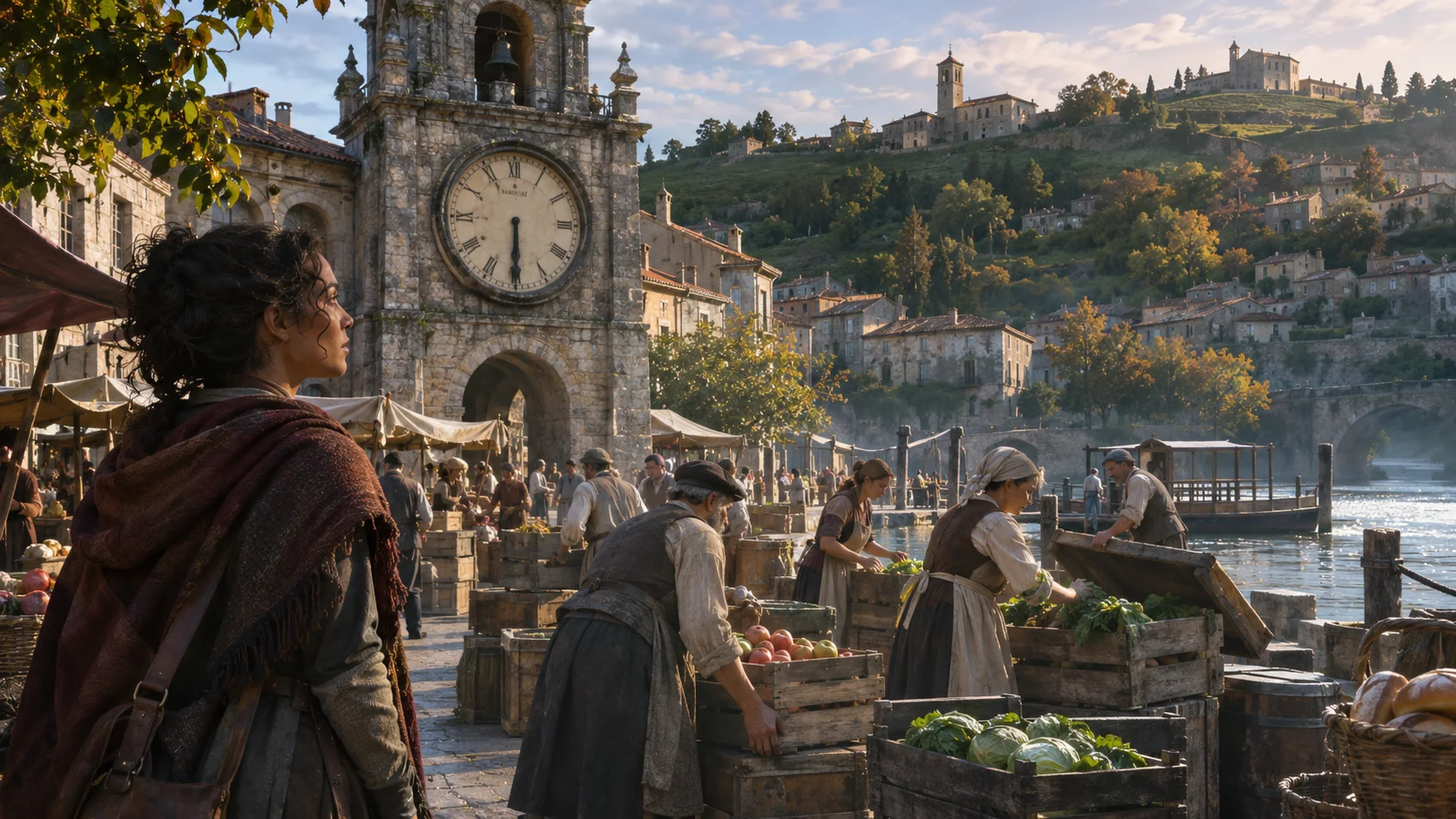
Illuminara came down the Varna road at noon by the hill's clock and found a town of three thousand one hundred people standing on two different days. At the ferry landing, the school and the market it was early morning again. In the streets between it was afternoon, and in the streets beyond that the afternoons had begun to stutter: a baker whose oven went cold between one loaf and the next, a woman who walked into her kitchen and could not say which day she had left it.
Councillor Mira Halse met her at the toll bridge with a map on which the edge districts were inked in red.
HalseWe have a visitor, The Guest of the Ninth Bridge. It has stood there since the first Tuesday and says it is sorry. Every time it comes back the red grows by a street. We have been moving people up the hill, and the hill has beds for nine hundred, and the ones we moved still wake at six not sure of the day.
She folded the map.
HalseThe council meets at four. I mean to put a motion to end this, by whatever vote it takes. I would rather put yours.
IlluminaraKeep moving them, It buys you days, and it is right. It cannot end this: three thousand one hundred will not fit in nine hundred beds, and the red does not wait for the beds.
She asked to see the Guest first, and she asked one other thing. She had Wren Odira stay on the hill side with a stopwatch and a ledger, because someone had to keep ordinary time while she stood in the loop's. A watch that has never been inside an hour cannot be talked out of what it says.
02 · Three Replays
The Ninth Bridge landing · three replayed hours
On the way down she passed the ferry office, where the notices hung under glass: fares, the river tables, and Standing Order 11 of 1911, which required the landing hook to be kept clear at casting-off. She read it the way one reads weather, and went on.
The Guest stood at the rail of the Ninth Bridge landing, tall as a ferry mast and dressed in a ferryman's coat that did not quite agree with its edges. It saw her at once, and all at once: it said that she had arrived, was arriving, and had left by the toll road, and that it hoped none of these was a discourtesy. It perceived the whole of time the way a person perceives a room. It could not walk out of the one hour in which it had failed.
The hour ran from ten past four to ten past five, and the Guest told her its rule in the plain way a ferry states its fares. An errand like its own ended only if the thing carried was still burning when the hour closed, in the keeping of someone who had lived through the last of it; then the hour closed behind it and did not open again. Otherwise, at ten past five, the edge districts snapped back to six in the morning, and it began again at ten past four with the same weight in its hands and the same shame. It could see its other Tuesdays as one sees other rooms through open doors. It had tried them all, and could not make any of them different from the inside.
Illuminara asked the obvious question first: had it simply asked someone to hold the flame through ten past five? The Guest answered the way a surveyor answers about a boundary. Every Tuesday was a room already lived, it said. It could stand in one and answer anyone who walked in from outside the hour. But the people inside could follow only the branches they had lived, and nobody inside had lived one in which the lantern crossed the seam. It could watch what happened in a room. It could not begin, inside a room, something the room had never held.
Illuminara took three replays to read it. She did not argue with the Guest or comfort it. She had carried a pocket watch and a notebook down the road from Wednesday, and when she asked why they alone were not put back at each snap, the Guest said that an hour returns only what it made, and it had not made them. By the third replay she had a page of marks.
Two things never changed. At 16:10:30 Anselm Rook came down the infirmary stair beside the ferry office and stood at the landing rail, because his daughter Pia was upstairs in the infirmary bed, nine years old, with a heart that would stop that evening, and he could not breathe in the room. And at 16:11:20 the ferry horn blew its warning and covered the Guest's first sentence, which began, I have been carrying.
Two things changed each time. The Guest lit a ferry lantern, and its flame was a different colour in each replay: white on the first, amber on the second, green on the third. They were the four signal lamps in their round, and each told one layer of the errand it carried: the ship's business, the crossing, the child, the next of kin. The colour said which part of the errand was being told, not who was hearing it. And the lantern went to someone different. First to Anselm, who looked at it as a man looks at a lit window in a house he will not enter, and climbed the stair. Then to the ferrymaster, Cato Brandt, who put his hands behind his back. Then to Pia's teacher, Joss Maren, who carried it as far as the infirmary door, where Anselm shut the door on both of them. Each time the end was the same: the lantern went on the landing hook, hung there by the Guest after two refusals and by Joss after her failure, because a ferry lamp has nowhere else to go.
Joss lingered by the hook after she had hung it.
JossPia used to answer its light from the window with a candle, For months. She told me she had asked it to carry something to her father, for after. She would not say what.
IlluminaraIt tries someone new each time.
Illuminara and Wren stood afterward by the hill's clock.
IlluminaraThat is what a message looks like when it cannot find the person it was meant for.
03 · The Man Who Stayed Upstairs
The toll bridge · dusk, during the fourth replay
AnselmIt could be me.
He had come out to the toll bridge at dusk, and he spoke to the river rather than to her.
AnselmIsn't that what you're thinking? That I am making it. That the lamp is only my grief, standing in a coat.
IlluminaraIt is the best rival I have, A lantern made of your grief would follow you. When you were present it would show you; if you left, it would change or go out. The colours are the Guest's own round, and a round does not know where you are standing. I have a prediction, and it can embarrass me. On the fourth replay the flame will be blue, whether or not you come down the stair.
She wrote it on a card and gave it to Halse, who had come out behind him with the council's motion in her hand, because Halse stood on the hill side of the hour and a card there could not be put back.
He did not answer for a while.
AnselmYou want me to stay upstairs.
IlluminaraI want to know whether you will. It is your hour with her, and you may spend it as you like. I will not ask twice.
Halse said what she had been waiting to say, and it was not small. If ending the loop needed one man's hour, then three thousand one hundred people could vote to take it; his grief was not a veto over everyone else's days, and she had buried enough of the town's Tuesdays already.
IlluminaraI do not yet know what ends it, I know that a part you force is no longer the part you needed, and that if I am right and he is not the lock, you will have taken a father's last evening for nothing. Hold the vote until the card is read.
Halse looked at the card and then at the man at the rail.
HalseUntil the card is read.
On her fourth replay Anselm Rook did not come down. He stayed at the bedside, holding a hand that was still warm in a day that would end, and the landing was empty at 16:10:30. At 16:11:20 the horn blew. The Guest lit its lantern and the flame was blue. It offered the lamp to Cato Brandt, who put his hands behind his back, and then it hung the lamp on the hook.
On the hill side Halse read the card against Illuminara's notebook: blue, Anselm absent, Cato, the hook. She read it twice.
HalseThen it is not his.
Halse put the motion into her coat. She did not call off the evacuation.
HalseBoth, You do not choose which of my plans I trust.
04 · Twenty Seconds
The Ninth Bridge · the fifth and sixth replays
WrenIt knows the whole hour.
Wren stood at the toll bridge, holding her stopwatch as though it might be taken from her.
WrenSo why can it never finish handing over a lamp?
Illuminara went back down and asked the Guest a different question. Not what it was carrying, but what it saw last.
The GuestThe lamp on the hook, burning, The ferrymaster looking at the river. Then I am at the beginning.
By her pocket watch the Guest's sight closed at 17:09:40. The snap came at 17:10:00. For twenty seconds, then, there was an hour the Guest did not see, and only someone living forward through it could say what happened in it.
For four replays she had watched the Guest. On the fifth she watched the hook. Wren had come down to the ferry office door against her advice, and the white lantern hung on the hook with nobody near it. At 17:09:40 the Guest's gaze closed like a door. At 17:09:45, a quarter-minute before casting off, Cato Brandt walked along the hook, put out the lantern with two fingers and the flat of his glove, as he put out every light that was not the ferry's own at every casting-off, by the standing order of 1911, and stood looking at the river. He did not remember doing it. At 17:10:00 the town went back to six in the morning, and only Illuminara knew what he had done.
She told the Guest on her sixth replay, at the rail.
IlluminaraThree people turned your lantern down and one could not deliver it, and none of that is what ended your hour badly. The hook did. Whatever happened to the lantern before, it hung there alone in the twenty seconds you cannot see, and the ferryman whose order is to keep that hook clear put it out. You have been judging an errand that ends in a place your sight does not reach.
The Guest heard this and was silent for what might have been a minute or an afternoon. Then it said it was glad someone lived forward, and that it had been wrong about the nature of its failure for a very long time. It had thought it was being refused. It said, too, that it could not have found this alone: its sight ended before the hook was touched, and every room it could walk into was a room where the hook had already been left. It would like very much not to be right in that way again.
05 · Wednesday
Ostrel · the seventh replay through Thursday
Her seventh replay was arranged around three requests, and she was granted two of them whole and the third on someone else's terms. She asked the Guest to light blue on purpose, first, instead of waiting for the round to come to it, because blue was the layer for the next of kin and the errand had never been meant for anyone else. The Guest, whose round would have brought it to green, lit blue before anything else. The colours had told her only whose part of the errand it was when it came round, and that was all she had ever claimed for them.
She asked Cato Brandt, who distrusted anything that stopped a clock, to keep the lantern past the seam, and he said he would not bend the standing order for a stranger. She put her page of marks in his hand: 17:09:45, his glove, the hook. Then he heard that the order was what had put the lamp out. He bent it himself, on his own terms. He would hang the Guest's lantern on the hook as the ferry's own departure lamp, which the order allowed him to do, and stand beside it through the quarter-minute with his hand on the hook; the ferry would cast off with it burning, cross the river and come back. No one on the council had the authority to alter his terms, and none tried.
The third request she did not win. She asked Anselm Rook to come down and take the lantern at the landing, and he said that if he took the lamp he would have to read what his daughter had said, and that he would not read it while she was alive on the floor above him. He would sit with her until she stopped, and he would not be hurried and would not be voted on. He asked that the lantern cross the river and the night and be given to him on Wednesday, at dusk, at his kitchen door, by whoever could be trusted to knock. Then he went upstairs and shut the door.
Halse took off her glasses.
HalseWho is to knock?
IlluminaraCato, He is the one who carries it past the seam.
The ferry cast off at ten past five with a blue lamp swinging from the hook and Cato Brandt's hand beside it. The seam came, and nothing snapped back. The market clock on the riverside struck six in the evening, which it had not done in nine Tuesdays, and then seven, and then, a long time after anyone had expected it, it kept going. Pia Rook died at twenty past eight with her father's hand around hers, and the infirmary window looked out on a landing that for once had no one standing at the rail.
On Wednesday the school bell rang for a Wednesday. The red streets on Halse's map went grey one by one, though some of them stayed faint for weeks: a woman who still woke not sure which day it was, a baker who forgot his own loaves twice a month, and families on the hill who went home slowly and not all at once. At dusk Cato Brandt walked up to a kitchen door in the hill district with a lantern, knocked, and said nothing. Anselm Rook opened the door and looked at the Guest, who stood behind the ferryman in the dusk, and for a long moment he did not hold out his hand. Then he did.
The Guest put the lantern down in his hands. It spoke its first sentence to the end, without a horn to cut it, and said what a child had asked it to carry across a river that was not water, and the man at the door listened with his eyes shut. Afterward it said to the river that a branch in which the lantern crossed the seam was one no one inside the day had ever lived, and that it could not have begun one: it had come in from Wednesday on a stopwatch, and been kept by a man bending his own order. Then the Guest walked back down the hill and stopped being the Guest of the Ninth Bridge. It was only a visitor on a road, in a town that had gone on to Thursday.